
HAZID • HAZOP • ALARP • Human factors
HAZID & HAZOP Studies
Independent, structured hazard studies for projects and operating facilities—from early-stage HAZID workshops through to detailed, guideword-based HAZOP studies for mature process designs.
ExConform facilitates multidisciplinary teams to identify credible hazards, challenge process deviations, evaluate safeguards, prioritise actions and demonstrate that risks have been reduced to a level that is As Low As Reasonably Practicable.
The right study at the right project stage
From Early Hazard Identification to Detailed Operability Review
HAZID and HAZOP are complementary Process Hazard Analysis methods. A HAZID is normally used during concept selection, feasibility, front-end engineering or other early project phases, when the objective is to identify major hazard themes and influence the design before key decisions become difficult or expensive to change.
A HAZOP is most effective once the process design is sufficiently mature and the intended operating conditions, process flow diagrams, piping and instrumentation diagrams, control philosophy and safeguarding arrangements are available for detailed review.
HAZID Study
A structured, multidisciplinary review used to identify credible hazard sources, major accident scenarios, affected people and assets, environmental impacts and the principal prevention or mitigation measures required by the developing design.
HAZOP Study
A detailed, guideword-based examination of how process conditions can deviate from design intent, what can cause each deviation, the consequences that may follow, whether safeguards are effective and what further actions are justified.
How the study is delivered
A Clear and Traceable Study Process
Effective HAZID and HAZOP workshops depend on good preparation, the right multidisciplinary team and disciplined facilitation. The study process is structured so that assumptions, discussions, decisions, risk rankings and recommendations can be followed from workshop preparation through to final close-out.
HAZOP study preparation
Noding Turns a Complex P&ID into a Structured Review
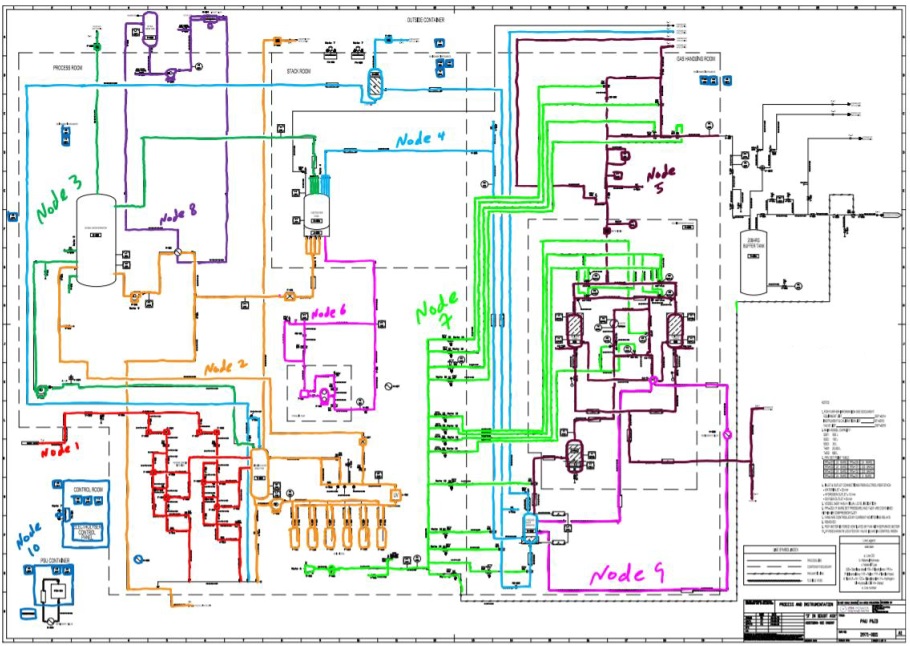
A detailed HAZOP is normally performed node by node, rather than reviewing an entire facility as one system. Before the workshop, the process is divided into manageable sections that share a coherent design intent, operating conditions and set of process parameters.
Node boundaries are marked on the current P&IDs so the team can see exactly which equipment, lines, instruments and interfaces are being reviewed. The colour-coded example illustrates how a complex process can be separated into distinct study areas, helping the team maintain coverage, avoid unintended gaps or duplication and follow a logical workshop sequence.
For every node, the facilitator confirms the design intent and relevant operating modes before applying suitable parameters and guidewords. The proposed node list is agreed during preparation and may be refined during the workshop where the team identifies a more effective study boundary.
Detailed HAZOP worksheet
Every Scenario Is Recorded with a Clear Audit Trail
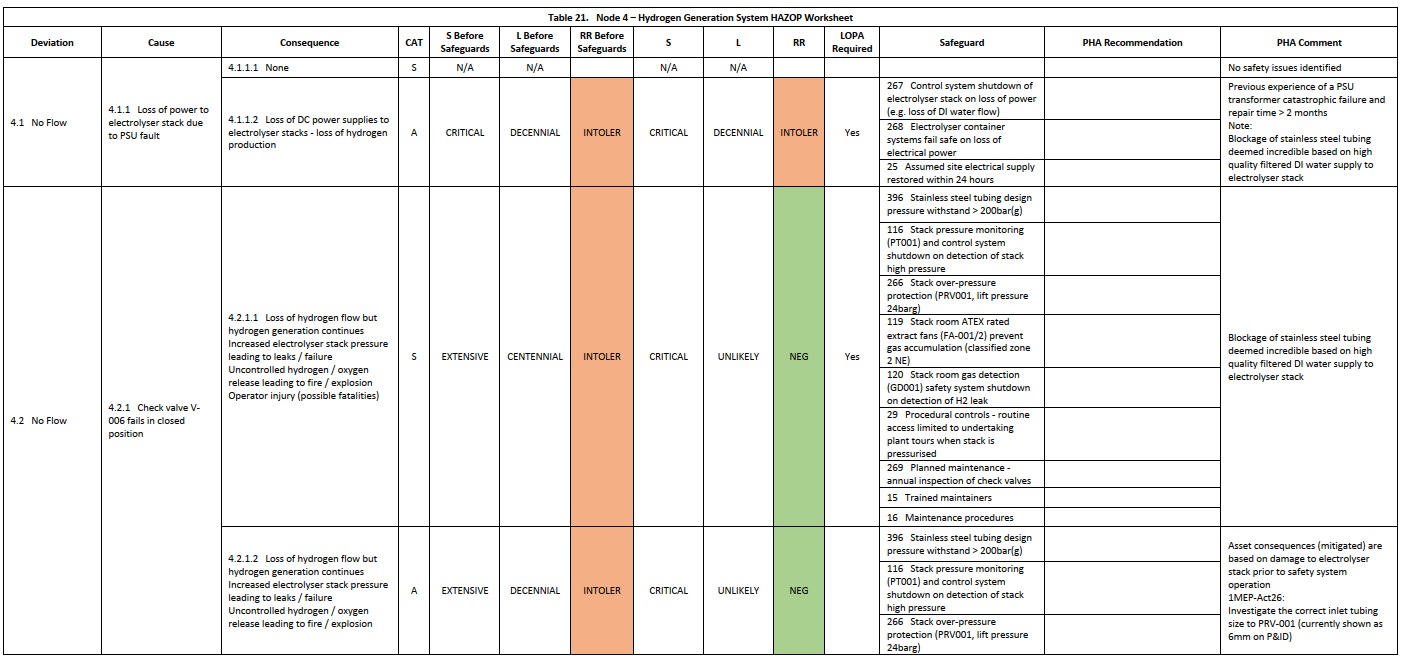
The example worksheet shows a HAZOP node for a hydrogen generation system. The study begins with a process deviation such as No Flow, then records credible causes and consequences before assessing the risk both before and after safeguards.
The worksheet structure supports traceability from the initiating cause through to the final recommendation. It also identifies whether a scenario requires escalation to a more detailed Layer of Protection Analysis.
Risk ranking and decision support
Consistent Risk Classification and Demonstration of ALARP
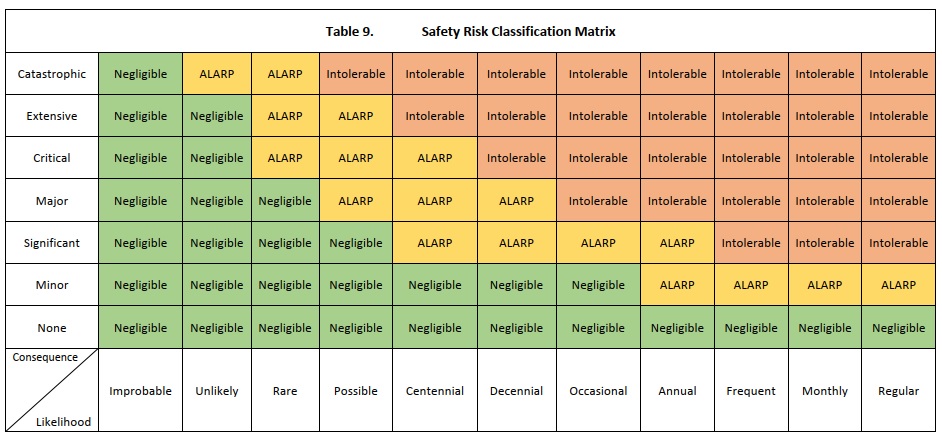
The risk matrix provides a transparent basis for comparing scenarios and deciding where additional safeguards, further analysis or management attention are required. The example matrix combines consequence categories—from none through to catastrophic—with likelihood categories ranging from improbable to regular.
Scenarios within the ALARP region require a reasoned demonstration that further risk reduction measures have been considered and that additional measures would be grossly disproportionate to the benefit achieved. Intolerable scenarios require further risk reduction before the activity can be accepted.
ALARP Is More Than a Colour on the Risk Matrix
A defensible ALARP demonstration records the options considered, the effectiveness and practicability of additional controls, the reason for accepting or rejecting each option, and the responsibilities and timescales for agreed improvements.
Our facilitators encourage the team to consider the hierarchy of controls and the complete lifecycle of safeguards, including design, operation, inspection, testing, maintenance, proof testing, competence and management of change.
Facilitated by Experienced Process Safety Personnel
HAZID and HAZOP studies are facilitated by experienced personnel with strong practical experience in the energy sector, aerospace industry, hazardous chemical processing, waste treatment and effluent treatment systems.
This experience helps the workshop move beyond generic prompts and focus on credible equipment failures, process interactions, operating modes, human-system interfaces and safeguards that can be implemented and maintained in real facilities.
Human performance in process safety
Human Factors Are Integrated into the Study
Process deviations are not caused only by equipment failure. Procedures, workload, interfaces, alarm design, access, communication, competence, staffing and maintainability can all influence whether a hazardous scenario is initiated, detected or successfully controlled.
Human Factors Trained Facilitation
Our facilitators have completed Human Factors training through an IChemE course and use that knowledge to challenge assumptions about operator action, task reliability and human-system interaction.
Operator Response
Where a safeguard depends on human action, the study considers detection, diagnosis, available response time, workload, access to information, competing tasks and the clarity of the required response.
Procedures and Operating Modes
The review includes normal operation as well as start-up, shutdown, maintenance, isolation, sampling, cleaning, testing and foreseeable abnormal or temporary operating conditions.
Control Room and Alarm Interfaces
The team can examine alarm presentation, prioritisation, suppression, set-point rationale, control system indications and the potential for ambiguous or misleading information.
Maintenance and Testing
Safeguards are challenged for accessibility, testability, proof-test coverage, bypass management, restoration after maintenance and the possibility of common-cause or latent failures.
Organisational Controls
Competence, supervision, shift handover, contractor interfaces, permit-to-work, simultaneous operations and management of change are considered where they influence scenario likelihood or safeguard performance.
Sector experience
Typical Facilities and Process Systems
The facilitation approach is adapted to the process technology, hazard profile, project phase and operational context. Typical applications include new projects, modifications, packaged units, brownfield interfaces and revalidation of existing facilities.
Hydrogen and Electrolyser Plants
Electrolyser stacks, water treatment, gas-liquid separation, purification, drying, compression, storage, pressure control, venting, detection and emergency shutdown.
Hydrogen Refuelling Stations
Delivery, generation, compression, cascade storage, pre-cooling, dispensing, vehicle interfaces, pressure protection, vent systems and hazardous-area controls.
Hazardous Waste Incineration
Waste receipt, transfer and storage, burners, combustion chambers, auxiliary fuel, reagent systems, flue-gas treatment, residues, emissions and utility failures.
Aerospace Tank Farms
Bulk chemical storage, unloading, transfer, overfill protection, bunding, incompatible materials, vapour release, drainage, emergency isolation and distribution systems.
Chemical Processing Lines
Process baths and tanks, corrosive and highly toxic chemicals, heating, dosing, agitation, extraction, rinsing, cleaning, transfer and abnormal reaction scenarios.
Effluent Treatment Plants
Collection, segregation, neutralisation, precipitation, pH control, chemical dosing, gas generation, sludge handling, storage and discharge-quality protection.
Study preparation
Information Required for an Effective Workshop
The exact input package depends on the project stage. Missing or uncertain information does not always prevent a study, but assumptions and data gaps should be identified before the workshop so they can be managed transparently.
Typical HAZID Inputs
Project description, design basis, process overview, site and plot plans, inventories, preliminary flow diagrams, technology information, surrounding receptors, interfaces, environmental constraints and applicable risk criteria.
Typical HAZOP Inputs
Current P&IDs, preferably marked with proposed node boundaries, together with the process description, design and operating data, equipment information, control narrative, cause-and-effect charts, alarm and trip philosophy, relief information, utility details and operating procedures where available.
Workshop Arrangements
Agreed scope, node list or HAZID categories, risk matrix, attendee roles, workshop schedule, document revision status, action ownership protocol and a suitable method for remote, hybrid or in-person participation.
Multidisciplinary participation
The Workshop Team Matters
The facilitator provides the method and keeps the study systematic, but the quality of the output depends on combining design knowledge with practical operating experience. The core team should be proportionate to the system and should include the people able to explain the design intent, challenge failure scenarios and judge whether safeguards are realistic.
ExConform can support workshop planning, attendee selection, node preparation, pre-reading and alignment of the study with the client’s approval and action-management processes.
HAZID / HAZOP Deliverables
Deliverables are structured to provide a usable study record, clear action ownership and a complete technical basis for project assurance, design development, operational risk management and future revalidation.
When to commission a study
Typical Project and Operational Triggers
HAZID and HAZOP are not limited to greenfield projects. They can support design assurance, modification control, commissioning readiness and the periodic review of existing facilities.
Concept and FEED
HAZID to identify major hazards, compare concepts, influence layout and determine the studies required as the design develops.
Detailed Design
HAZOP when P&IDs and control arrangements are mature enough for a systematic node-by-node review.
Design Change
Focused HAZID or HAZOP for new equipment, capacity increases, process changes, new chemicals, control changes or altered operating envelopes.
Pre-Start-Up Assurance
Review of open recommendations, design changes made after the study and the readiness of safety-critical safeguards before operation.
Operational Revalidation
Periodic confirmation that the previous study remains valid and that plant changes, incidents, degradation and operating experience have been considered.
Incident and Learning Review
Targeted re-examination of scenarios where incidents, near misses, audit findings or industry learning challenge previous assumptions or safeguards.
Common questions
HAZID and HAZOP FAQs
What is the difference between a HAZID and a HAZOP?
A HAZID is a broad hazard-identification study suited to early project phases and high-level systems or site interfaces. A HAZOP is a detailed, guideword-based study normally performed when the process design and operating intent are sufficiently mature for node-by-node examination.
Can a HAZOP be completed before the P&IDs are final?
Yes, provided the design is sufficiently developed and the document status is understood. The benefit of early review must be balanced against the risk of repeated work. Design gaps and assumptions should be recorded, and significant changes after the workshop should be screened for re-HAZOP.
Does a HAZOP demonstrate that a design is safe?
A HAZOP provides structured evidence that deviations, causes, consequences and safeguards have been examined by a competent team. It does not replace good engineering, verification, quantitative analysis, commissioning controls or lifecycle management of safeguards.
When is LOPA required after a HAZOP?
LOPA may be appropriate where a scenario remains significant, where the adequacy or independence of protection layers must be demonstrated, where a safety instrumented function may be required, or where the organisation’s risk criteria specify escalation to semi-quantitative analysis.
Can the study be facilitated remotely?
Yes. Remote or hybrid studies can be effective when documents are well controlled, the platform supports clear drawing review, participants have reliable access and the sessions are planned to manage attention and fatigue. In-person workshops may be preferred for complex systems, site walkdowns or teams unfamiliar with the process.
Planning a HAZID or HAZOP Study?
We can support study planning, document readiness, node definition, multidisciplinary workshop facilitation, risk ranking, ALARP review, action prioritisation and complete reporting for new projects, modifications and operating facilities.